The Product Engagement operates through a series of interconnected layers. Each layer serves a distinct purpose, and alignment across all is key to success. It all begins with the vision, which should inspire and motivate your team to create meaningful impact.
Vision: Defines the Enduring Change
It defines why the product exists and what lasting change it wants to create in users’ lives.
Vision answers:
- Who is this product for?
- What problem should permanently disappear?
- What should be true in the user’s life if this product succeeds?
Vision is stable, long-term, and non-metric. Vision does not describe how users engage; it constrains which behaviors are acceptable.
Strategy: Identifying the Behavioral Model
The behavioral pattern you’re designing your product to create in users’ lives is the core of your strategy. Although multiple patterns exist, one typically dominates and serves as the foundation for engagement efforts, known as ‘engagement currency.’
Strategy answers: What behavior should this product intentionally compound over time?
Here are some examples of the behavioural patterns – Utility (Google-Photos), Habit (Social Apps), marketplace (Amazon), etc.
Design: Designing a system of value hierarchy
This layer translates strategy into a quantifiable system. It establishes the indicators that prove your strategy is working.
A core metric that predicts long-term success and typically depends on the dominant behavior pattern selected. This includes quantifiable indicators to indicate that your strategy is working. It involves a few components.
- Core Value – The repeatable value promise delivered at every stage.
- North star metric (Core Metric) – Measures the growth of engagement currency defined in the ‘Strategy’ phase.
- Engagement Tiers (Value Hierarchy): Segmentation of Users based on level of engagement. Each tier (level) has a definition and exit criteria that move users into the next bucket.
- Passive Users
- Active Users
- Engaged Users
- Committed Users
A typical definition of a tier would look like this. A user with X behavior for Y long time and receives the value Z. So behavior, Time & Value are the 3 factors that drive the definition of the tier.
All users are put through these tiers of engagement as value compounds.
Execute: Deploy Loops & Tactics for the User to move through the value hierarchy (Funnel)
These are the designed interventions that guide users toward desired behaviors. Each engagement tier (Passive user, etc.) has a defined Tactic (Nudge) or a set of nudges to guide the user along the intended path to progress. These Nudges trigger Engagement Loops; repeatable cycles of action and reward that push the user toward the “exit criteria” of their current tier.
The ‘Building’ Analogy
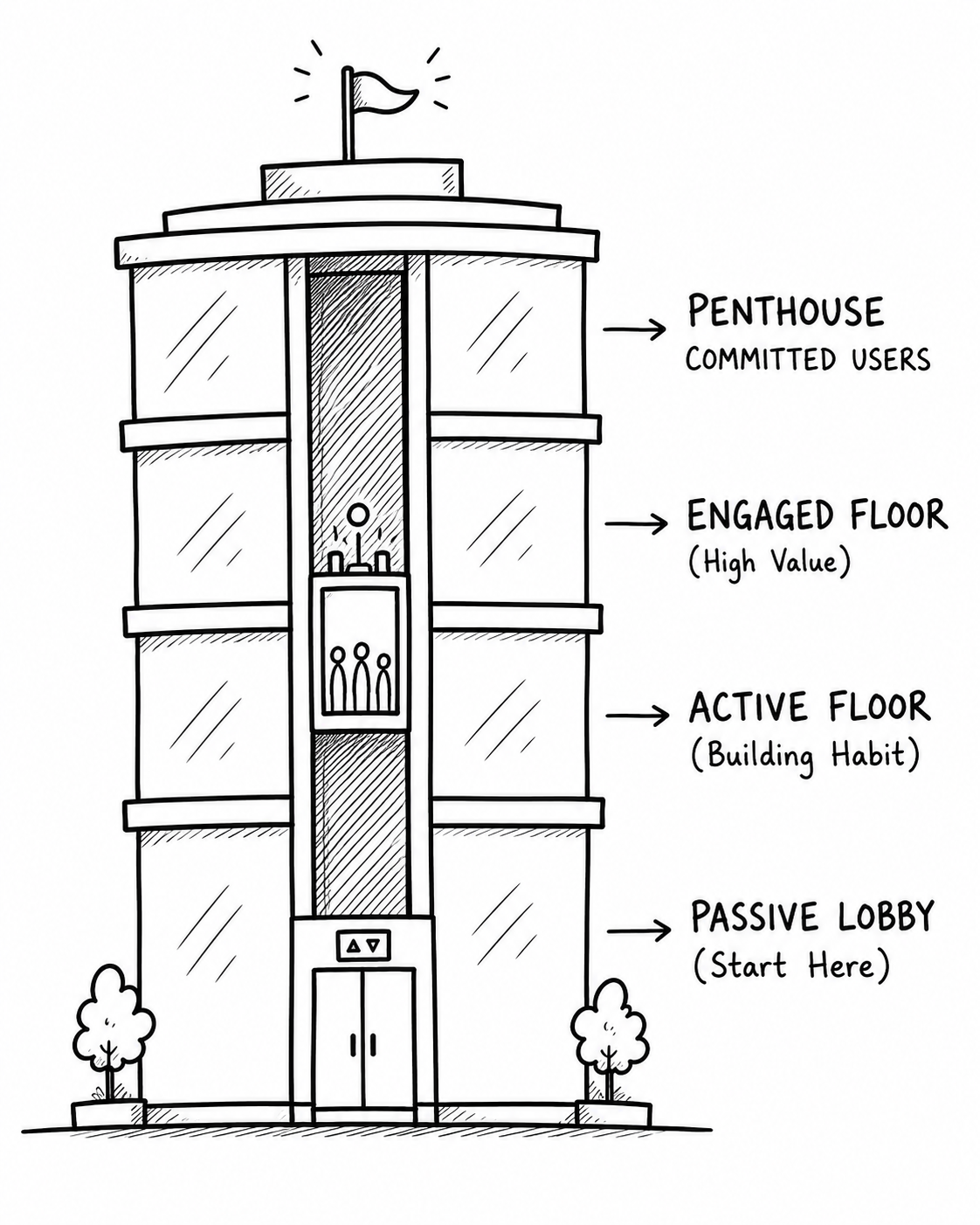
To better visualize this model, imagine you are constructing a high-rise. Your Vision is the blueprint, and your Strategy defines the building’s purpose. The Engagement Tiers are the floors, from the lobby to the penthouse, that represent the depth of value a user attains.
But floors alone are static. The Engagement Loop is the elevator that moves the user upward, and the Nudge is the glowing call button. Without the nudge, the user stands in the lobby, never knowing the penthouse exists; without the loop, you’re asking them to climb the stairs. A great product doesn’t just build higher floors; it ensures the button is impossible to miss and the elevator carries them to the top.
The goal of Engagement is not about tricking users into spending more time on your platform.
It’s about understanding the
- deep behavioral patterns that drive human action,
- designing a clear progression system that delivers exponentially more value at each stage,
- deploying specific tactics that help users climb that ladder, creating engagement loops
- ultimately delivering the value that your product intends to deliver
When done right, engagement transforms strangers into advocates, builds defensible competitive moats, and creates sustainable business outcomes that compound over time.
The Model Is A Loop, Not A Ladder
These four layers are not a sequence you complete once and move on from. They are a cycle you revisit continuously. What you learn from executing reshapes your Strategy. Strategy refinement redefines the engagement currency. A sharper engagement currency reveals new tiers in your value hierarchy. The model is a loop, not a ladder.
The best product teams do not build Vision once and file it away. They return to it every time execution data tells them something unexpected about what users are actually accumulating. They ask, “Is this what we meant to build? Is this the lasting change we intended to create?”
That question, asked honestly and repeatedly, is what separates products that build genuine engagement from products that manufacture activity.
Why This Matters
In the upcoming blogs, we’ll look at five products: Google Photos, YouTube, Reddit, LinkedIn, and Instagram. Each one operates through a different engagement currency. Each one has built a different value hierarchy. Each one deploys nudges that feel natural precisely because they were designed to feel that way.
But underneath all five, the same four layers are running quietly. Vision. Strategy. Design. Execute.
Once you can see those layers operating in a product you use every single day, you will not be able to stop seeing them. In every notification. In every default setting. In every moment, a product makes the next step feel obvious.
That is not cynicism. That is the enthusiast’s lens.