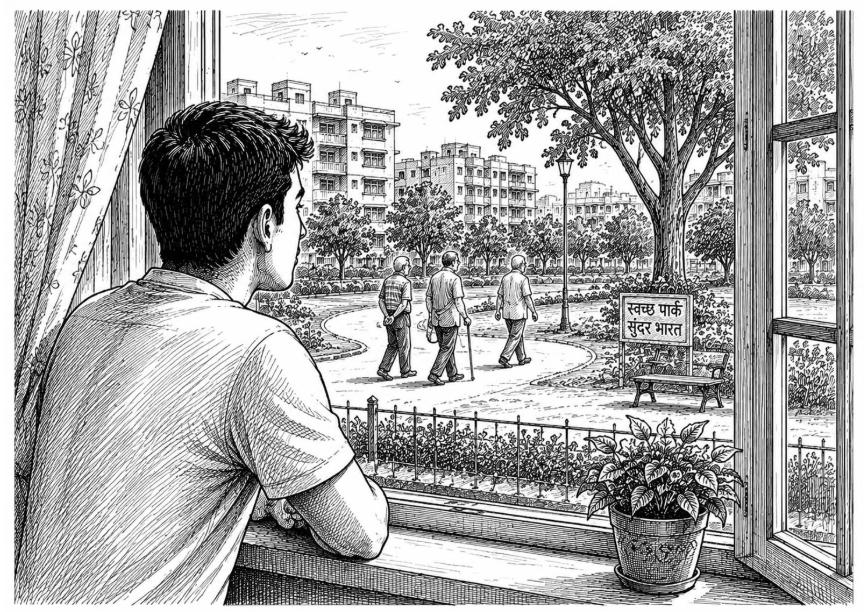
Last time, I told you about the park near my home. The senior citizens who showed up every single morning, rain or shine, without gear, without watches, without a single app tracking their steps. I told you it wasn’t discipline that held them there. It was a connection. The quiet comfort of being expected somewhere, by someone. I called it The Walker Effect, what happens when repeated participation quietly builds invisible stakes until leaving starts to feel like a loss.
I ended that post with a promise. That the mechanics behind this, the nudges, the loops, the specific architecture that turns a one-time visitor into someone who can’t imagine not showing up, deserved its own space.
So let’s go back to the park. Because it’s still holding the whole answer.
Nobody Handed Them a Roadmap. But There Was One Anyway.
Think about what actually happened in that park over months and years, even though nobody designed it on paper.
On day one, a walker was just a stranger doing laps. Passive. Unnoticed. Somewhere along the way, faces started repeating. A nod turned into a “good morning.” A “good morning” turned into a five-minute conversation about nothing in particular. Eventually, someone missed a day, and someone else noticed. That’s the moment a walker stopped being a visitor and became part of the group.
Nobody sat them down and explained this progression. Nobody said, “here’s what you need to do to belong here.” It happened in layers. Quiet, unannounced layers, each one requiring a little more of the person than the last, and giving back a little more in return.
That’s a value hierarchy. Not a funnel you’re pushed through. A staircase you climb because each floor genuinely feels better than the one before it.
Passive. Noticed. Known. Missed.
Four tiers. Nobody ever told the walkers this structure existed. They lived it anyway.
The Park Nudged Too. It Just Didn’t Look Like a Nudge.
Here’s the part I keep coming back to. If value sits in layers, something still has to move a person from one layer to the next. Value sitting there quietly, waiting to be discovered, isn’t enough. Somebody has to point at the stairs.
In the park, the nudge wasn’t a notification. It was a familiar face, slowing down to walk beside a newcomer. It was someone asking, “Didn’t see you yesterday- everything okay?” It was a group leaving a gap in their pace, almost without meaning to, so a slower walker could catch up and join the conversation instead of trailing behind.
None of that was designed in a boardroom. But it did exactly what a well-built nudge is supposed to do. It closed the distance between where a person was standing and the value they hadn’t discovered yet.
That’s the thing I want to be precise about. A nudge isn’t a trick to keep someone hooked. It’s closer to an obligation. If the deeper floors of your park, or your product, genuinely hold more value than the lobby, then leaving someone stuck at the lobby forever isn’t neutral. It’s a quiet failure. The walkers who noticed a missing face weren’t manipulating anyone into showing up. They were making sure nobody stayed a stranger longer than they needed to.
The Ones Who Stayed the Longest Weren’t Left Alone Either
Here’s something easy to miss if you only look at the newcomers. The walkers who’d been showing up for fifteen years weren’t just tolerated members of the group by that point. They were the ones organizing the small stuff. Deciding the route when it rained. Checking in on someone who’d been unusually quiet. Remembering birthdays nobody else remembered.
The group didn’t stop paying attention to them once they were “in.” If anything, it gave them more to hold. More responsibility. More small moments of being needed, not just included.
That’s easy to overlook when you’re thinking about engagement only as a problem of getting people in the door. The deepest layer of any value hierarchy isn’t “user finally sticks around.” It’s what happens after that. Whether the space keeps giving the most invested people a reason to keep investing, or whether it quietly stops paying attention to them the moment they’ve proven they’re not leaving.
Neglect wearing consistency’s clothes, showing the newest visitor the same face you show someone who’s been coming for a decade, is still neglect.
It Was Never a Straight Line
One more thing I noticed, looking back. The group in that park wasn’t the same group year after year. New routes were tried and abandoned. Conversations that used to matter faded, and new ones took their place. Somebody’s early morning slot changed, and the whole rhythm of the group quietly adjusted around it.
Nothing about that staircase was fixed. It bent and reshaped itself constantly, based on who was there and what they actually needed, not based on some plan drawn up on day one.
That’s the part that took me the longest to really sit with. A value hierarchy isn’t a structure you build once and leave standing. It’s alive. It has to be walked back into, questioned, rebuilt, the same way that park quietly rebuilt itself every single season without anyone calling a meeting about it.
The walkers had it figured out. They weren’t chasing consistency for its own sake. They were showing up for something that kept giving them a reason to. That’s the whole engagement model, hiding in plain sight, on a morning walk I almost gave up on.