In the peak of summer during my school days, we once boarded a train from Hyderabad to one of South India’s most famous temples -Tirumala (Andhra Pradesh, India). For my family, a visit to Lord Balaji’s shrine wasn’t just a trip; it was almost a tradition set in stone. The darshan had to be planned very well in advance. Even today, you need to plan your darshan months in advance due to the volume of footfall. On an average day, you stand in line for 4–5 hours (can go up to 10 hours) for what is ultimately a fleeting 15-second surreal glimpse of the Lord.
The closer we got to the main temple, the more my parents reminded me: “Stay alert, don’t blink, make the most of those few seconds.” I still remember my parents protecting us from the crowds, making sure we (my younger sister & I) didn’t miss the golden opportunity to witness Lord Balaji despite the chanting, the jostling, and the sea of people in the line pushing forward for the same view.
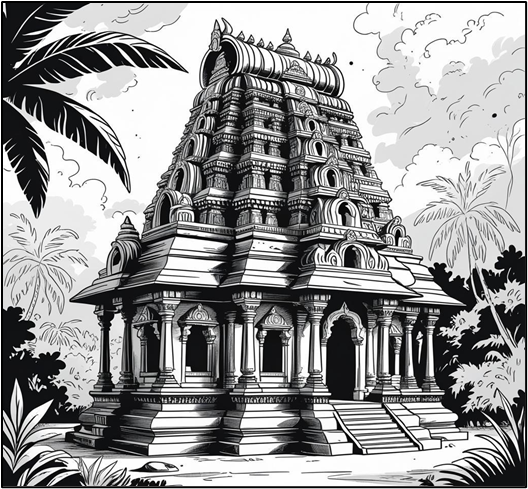
Figure: AI-generated image of a Temple
And then, the sacred moment arrived. You get that majestic sight of the Lord, and before you know it, it’s all over. The effort of traveling from your house and standing in line for hours seems completely justified and fulfilling. Mission accomplished! What’s the next logical step? Collecting the prasadam, the famous Tirupati laddu. While I was busy calculating how many free laddus we’d get this time, my parents were already replaying every detail of that 15-second experience, the flower garlands, the ornaments, the lamps (diyas) flickering around the statue, and how divine the Lord looked in those.
And then they turn to me to say, “Did you see the diyas? Did you notice how the light fell on the Lord’s face and made it glow?”
For a second, my sister and I saw each other’s faces, thinking about how to answer this tactful question. You know what the answer is. What could we say? Honestly, we hadn’t noticed even a fraction of what they described. So, we nodded in agreement, quickly changed the topic, and refocused on the laddus.
Years later, though, that question stuck with me. Why did I miss what they saw so vividly? Over time, I realised it wasn’t that I was careless, it’s just that we know what we’re ready to see. The mind filters the world through what we’re curious about, what we value in that moment. For me, it was just to finish the darshan and check this off. For them, it was enjoying the journey, the lamps, the flowers, the divine glow. I’ve come to see that it’s not really about what we miss, but how our perspective shapes what stays with us. Focus is a lens; it brings specific details into sharp view and gently lets the rest fade away.
It’s always that ‘lens’, that ‘view’, that ‘perspective’, that ‘dimension’, and that very ‘hat’ we choose to wear shapes what we see and, in many ways, who we become.